
Folke Rogard, President of FIDE - the lawyer who organised chess in the shadow of the Cold War
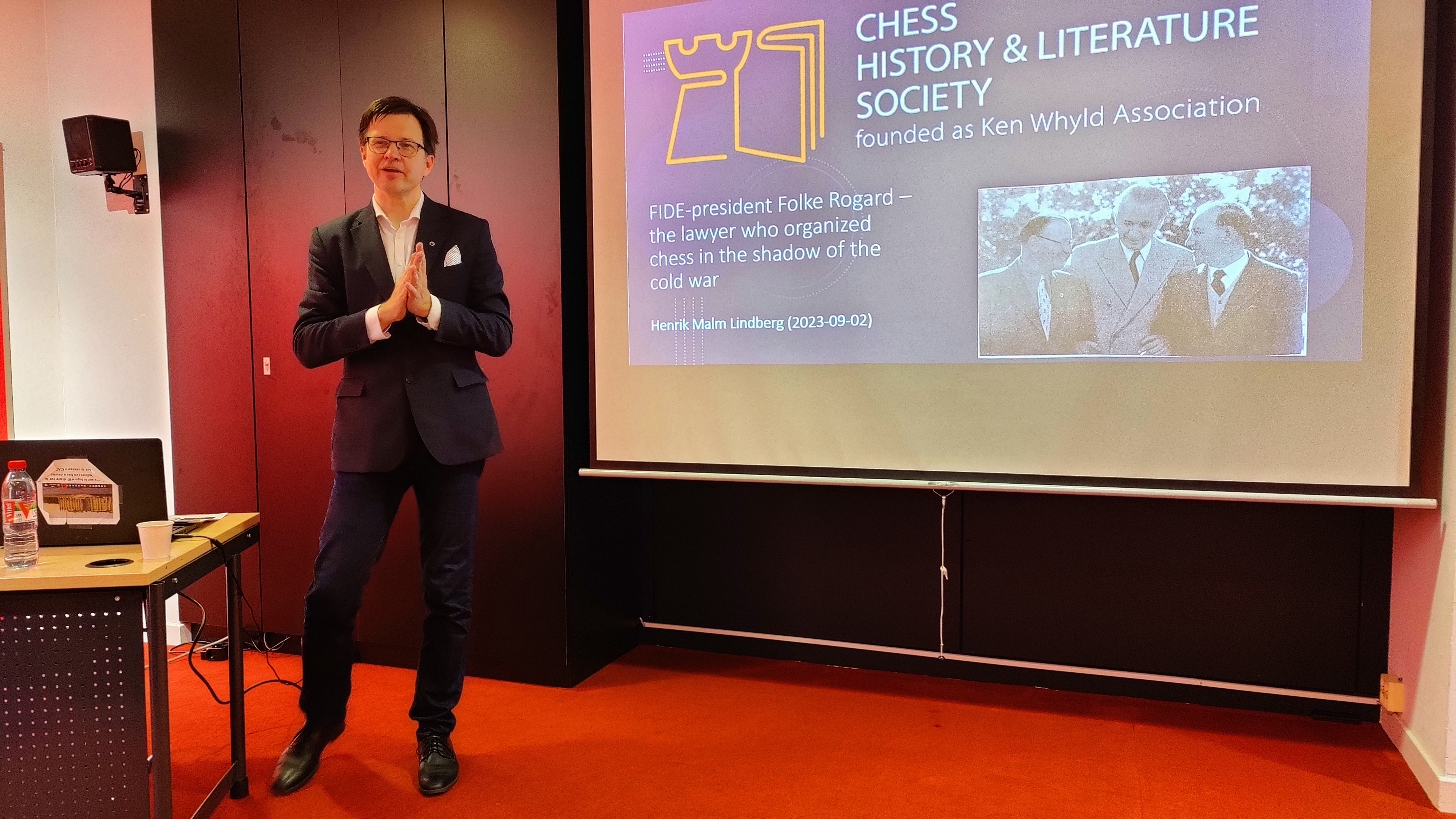
Here is the presentation given by Mr Henrik Lindberg (Sweden) at the CH&LS association's general meeting in Belfort.
Extract from the presentation at the AGM on Saturday 2 September: Annual Meeting of the CH&LS in Belfort
In German on the ChessBase website, by Herbert Bastian: Jahrestreffen der CH&LS in Belfort
Henrik Lindberg, assistant professor for economic history in Stockholm, reported in an extremely interesting lecture on the life story of the Swede Folke Røgard (*1899-†1973), lawyer and FIDE President from 1949-1970. Those who are interested in chess history during the Cold War can already look forward to the hopefully imminent publication of Henrik's book, as the title of the lecture reveals: Folke Røgard: organiser of modern world chess in the shadow of the cold war. Røgard was a well-known personality and made headlines, among other things, as the lawyer of the famous Swedish actress Ingrid Bergman (*1915-†1982), who was seen in the 1942 film Casablanca alongside Humphrey Bogart (*1899-†1957), incidentally also a chess enthusiast. Røgard got the FIDE World Championship cycle off the ground when the first interzonal tournament went to Saltsjöbaden in Sweden (1948). Through his good contacts on both sides, he also repeatedly succeeded in bringing the Soviet Union and the USA together, for example by preparing the bilateral match of 1955.
Rare books from the Jean Mennerat collection
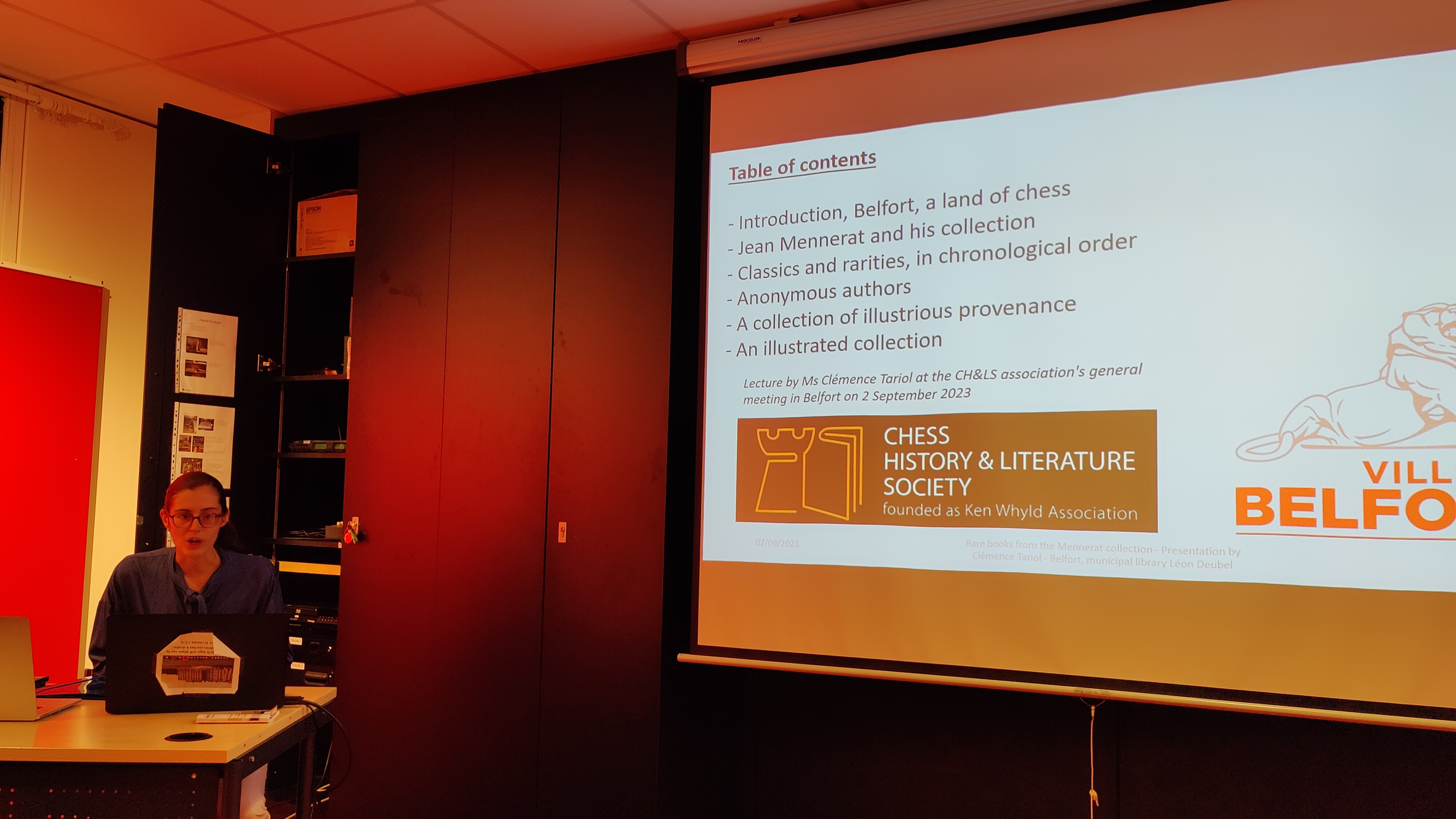
This is the text of the first conference held on Saturday 2 September at the CH&LS association's general meeting in Belfort.
The presentation was given by Clémence Tariol, curator of the Mennerat collection at the Léon Deubel library in Belfort.
Failing better. Beckett's game with chess in Murphy

by Dr. Bernd-Peter Lange
A game's trajectory
Beckett´s lifelong obsession with chess has become a household word. From his childhood with its games in the family, through his participation in matches of the chess team of Trinity College Dublin, facing the Danish master Aaron Nimzowitsch in a simultaneous exhibition, losing many chess games to Marcel Duchamp in his French exile, games in the Vaucluse hideout in the second World War to many occasional friendly games against many partners well into old age, Beckett never lost his fascination with the game. (Knowlson, 1996) The chess books in his library had a focus on the contemporary chess scene, specializing on game collections of the World Champions of chess from Capablanca in the 1920s to Kasparov in the 1980s. (Van Hulle/Nixon, 2013, 261-287) The most concentrated literary reflection of Beckett´s preoccupation with chess came early in his career with the writing and publication of Murphy. The novel is a rarity among thematically related fictions since it integrates the notation of a complete chess game and notes commenting on some of its moves.
Read more … Failing better. Beckett's game with chess in Murphy
Literature, women playing chess and Bertolt Brecht

The society has recently published a very interesting essay from our member Bernd-Peter Lange about the German playwright and poet Bertolt Brecht and chess playing women around him.
As it is in German, you can find the article in our German website here:
Ghosting Karl Marx. Hidden Agendas of a Muzio Gambit
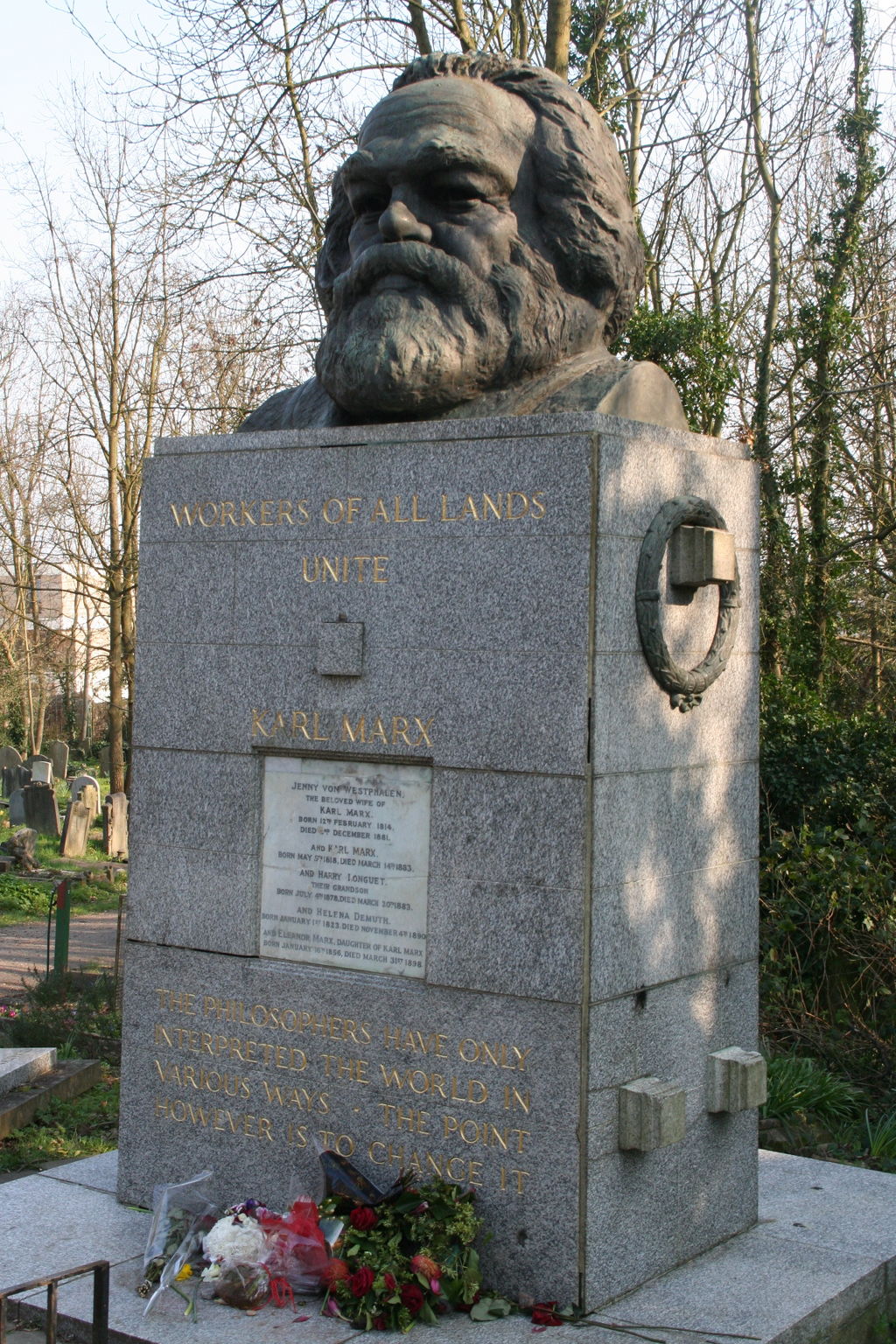
by Dr. Bernd-Peter Lange
The Marx that nobody Read
In a recent film directed by the Haitian director Raoul Peck, The Young Karl Marx, the eponymous hero appears as, among other better known pursuits, a genius on the chess board. In two of the scenes set in pubs he triumphantly checkmates Friedrich Engels and clinches a victory over his political rival, the Anarchist Bakunin by decisively pinning one of his opponent´s pieces.
Neither of these games in the film relies on documentary evidence. However, there are two notations of chess notations that Marx has been credited with for a long time, one an impressive win in a Muzio gambit against the contemporary problemist Heinrich Meyer, the other one a mating attack against the famous Prussian master Gustav Neumann, both around 1870. The notations of these games have been republished frequently in Russian journals from 1926 and 1938, respectively, but also in other countries, even though doubts on their authenticity have accompanied their publication throughout. In recent articles in chess journals, these doubts have peaked in definitive refutations of the involvement of Marx in the two games he has been credited with, albeit without much of an impact on the conservation of the view of the philosopher as chess prodigy.
Read more … Ghosting Karl Marx. Hidden Agendas of a Muzio Gambit
The long-forgotten Turkish chess automaton of the Italian Joseph Morosi

by Jean Oliver Leconte
In a previous article on my website (in French) I wrote about the visit of Kempelen's chess-playing Turkish automaton to Paris in 1783.
During my research I discovered many newspaper articles about a chess-playing Turkish automaton in Paris in the year 1800. At that time Kempelen was still alive and his automaton had not yet been sold to Johann Maelzel. But curiously, the name of the person who brought the automaton to Paris in 1800 was not Kempelen. In 1783, the newspaper articles mention a certain Anthon (who I have not yet identified). And in 1800, it is a certain Morosi. And that's when I thought something was wrong. And "Hey presto!", in the reference book "Biographie universelle, ancienne et moderne" (Paris 1843), we find in volume 74, page 417 a short biography of someone called Joseph Morosi (26-06-1772 - 27-09-1840) presented as an Italian mechanic born in Ripafratta, a small village in Tuscany. The text indicates:
Read more … The long-forgotten Turkish chess automaton of the Italian Joseph Morosi
The 1974 Nice Chess Olympiad
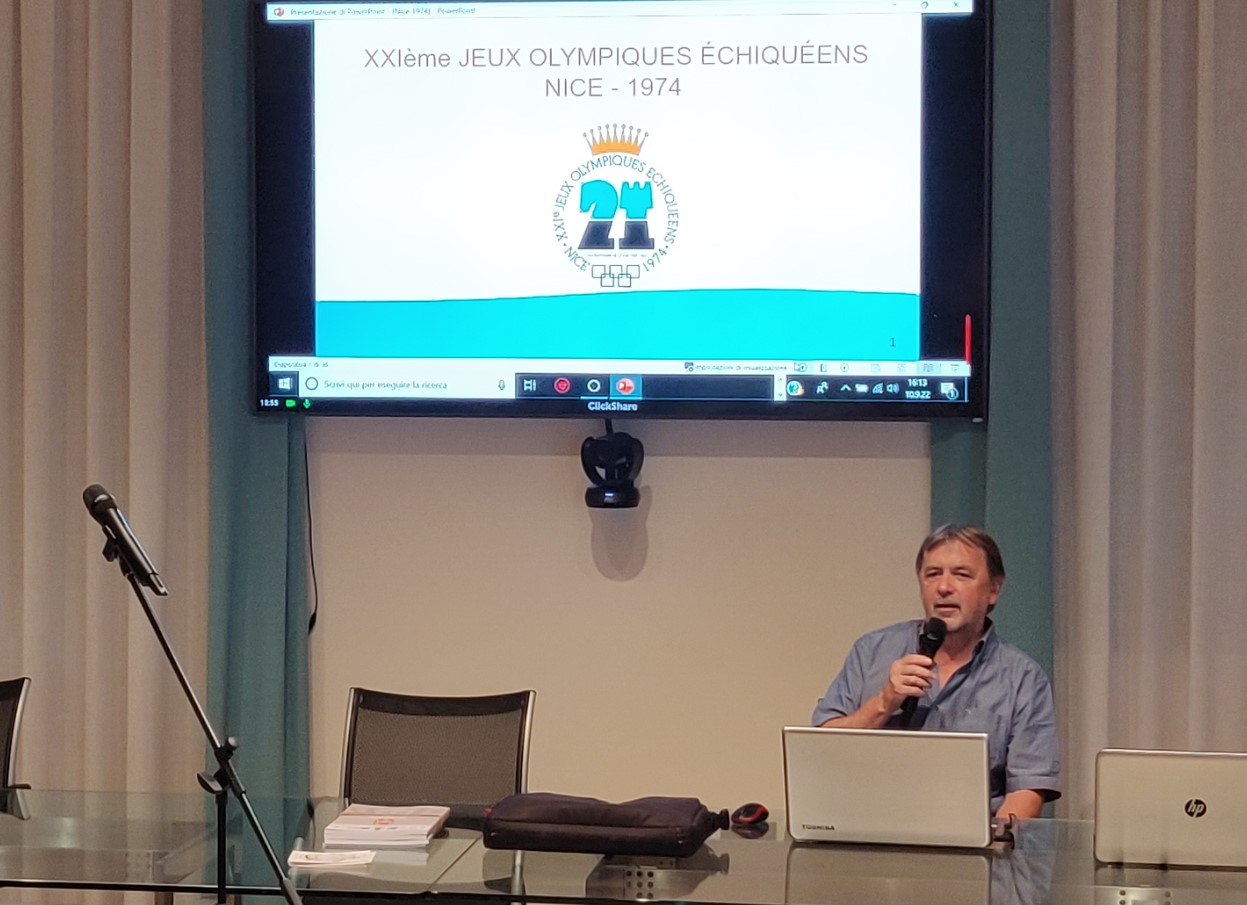
Dominique Thimognier, editor of the excellent site Héritage des Échecs Français, has presented the last conference in Marostica (Italy) on Saturday September 10th. You have below the support of his conference devoted to the 1974 Nice Chess Olympiad.
This is the only Chess Olympiad organized in France, except for the one in 1924, during the Olympic Games in Paris, which was considered as unofficial. Dominique Thimognier benefited from two testimonies of the time, with Michel Benoit, French champion 1973 and member of the French team in Nice, and Louis Risacher, referee during these Olympiads.
A difficult organization: with 10 times fewer volunteers than the previous Olympics, while many more teams took part, the hotel to accommodate the teams was still under construction, etc.
The 3rd World Junior Chess Championship in Antwerp, Belgium in 1955
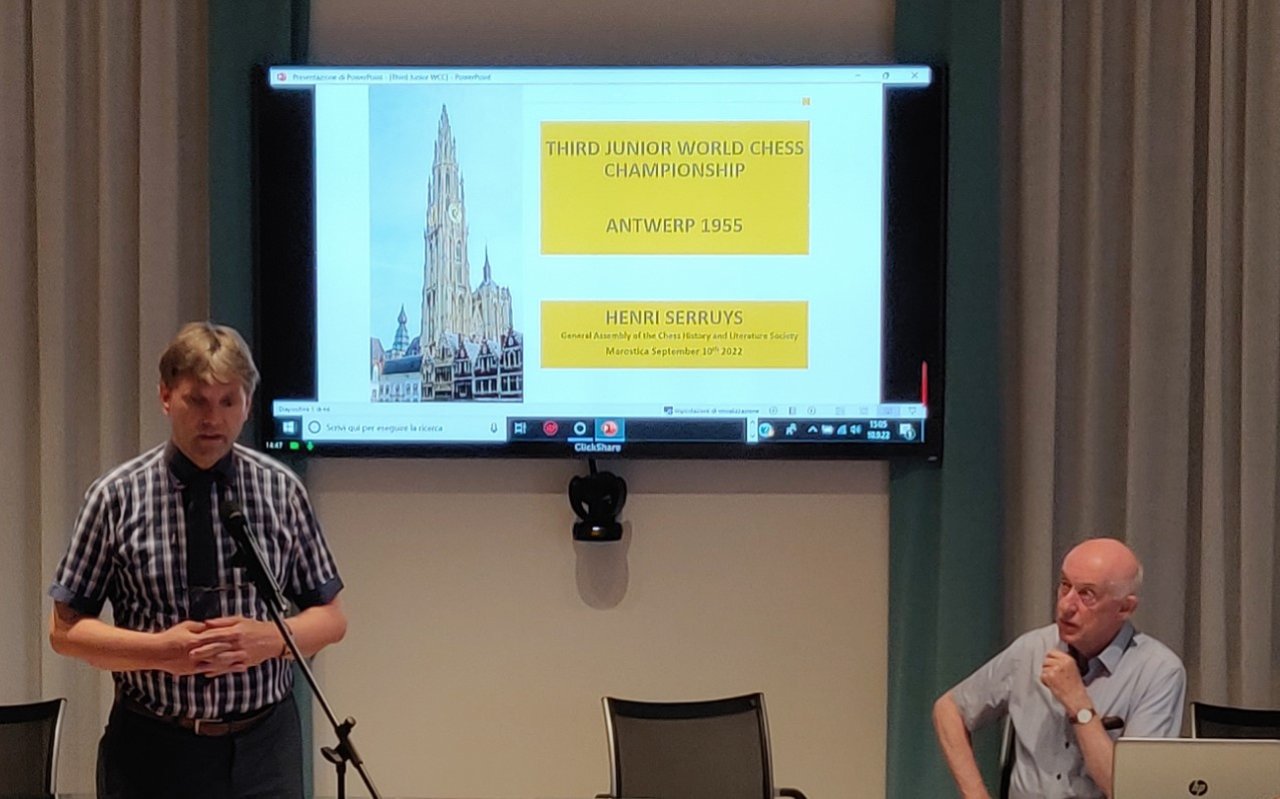
This is the material of the third lecture given in Marostica on Saturday 10th September 2022 during the general assembly of the international association CH&LS. The 3rd World Junior Chess Championship in Antwerp, Belgium in 1955, by Henri Serruys, treasurer of the association.
Read more … The 3rd World Junior Chess Championship in Antwerp, Belgium in 1955
Lasker's difficult journey after the First World War
This is the material for the second lecture given during the general assembly of the CH&LS association.
Frank presented the lecture "Lasker's Difficult Journey after the First World War" by Frank Hoffmeister, of which you have the support below.
Interestingly, one of the audience members added that Lasker had gone broke twice in his life. Firstly, just after the First World War, because he had invested in German government loans to finance the war, and then after the krach of October 1929.
Read more … Lasker's difficult journey after the First World War
Chess as a means of moral education in the Middle Ages
Here is the support of the first lecture by Björn Reich.
Read more … Chess as a means of moral education in the Middle Ages