

Philidor and the Game of Draughts
by Jean Olivier Leconte
Following in the footsteps of Sergio Boffa and his excellent book on Philidor (in French) (Le Café de la Régence), I set out to explore in greater depth what he had written about Philidor and the game of draughts. That is the subject of this article.
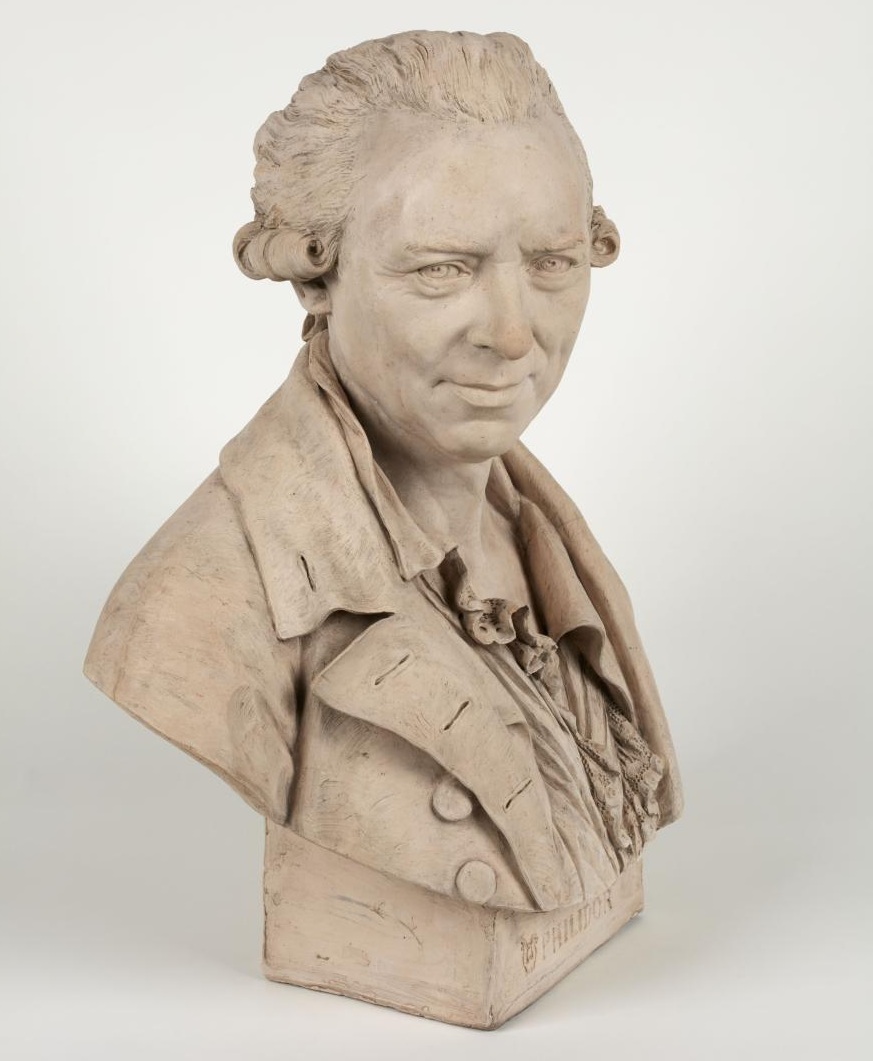
François-André Danican Philidor went down in history as the greatest chess player of his time. Far less well known is the fact that he also enjoyed a strong reputation as a player of Polish draughts, played on a board of one hundred squares.
How strong was he really at this game? The accounts are numerous and sometimes contradictory. We even have six positions attributed to him. And such was his reputation that, in 1785, a bookseller in Amsterdam did not hesitate to publish under his name… a treatise he had never written.
“The greatest player of Polish draughts”
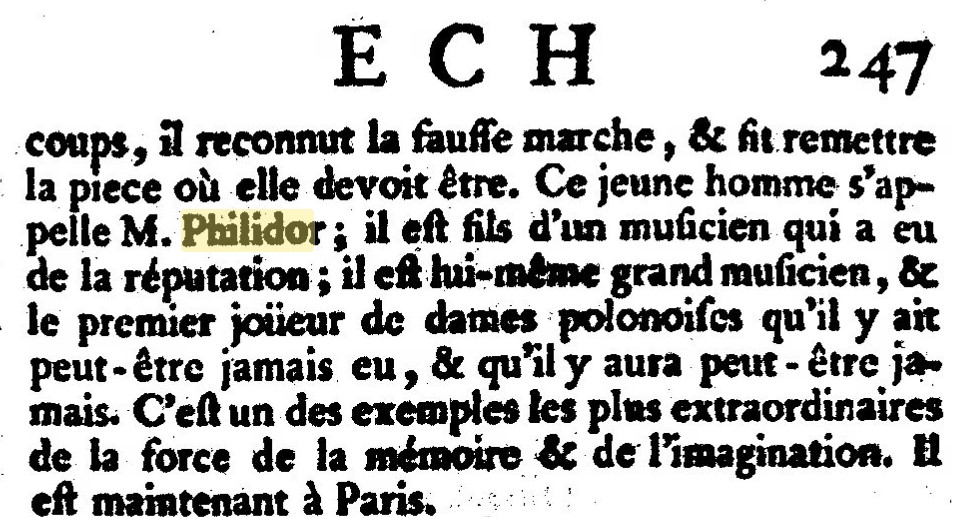
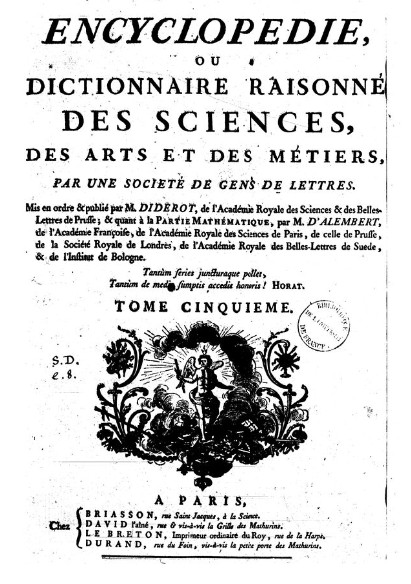
The first mention is striking. In 1755, the article “Chess” in the Encyclopédie described Philidor as “perhaps the greatest player of Polish draughts who has ever lived” (Encyclopédie ou Dictionnaire raisonné des sciences, des arts et des métiers, vol. V, 1755, article “Chess”).
Philidor was then not yet thirty years old. Fifteen years later, his reputation remained intact. In the Correspondance littéraire of 1 December 1770, on the occasion of the publication of Manoury’s Essay on the Game of Polish Draughts (Le Café de la Régence), we read:
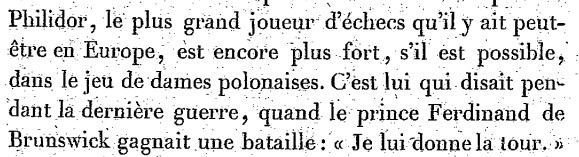
“Philidor, perhaps the greatest chess player in Europe, is, if possible, even stronger at Polish draughts.”
(Correspondance littéraire, philosophique et critique, 1 December 1770, ed. Maurice Tourneux, Paris, Garnier, vol. IX, p. 183 (Link: wikisource.org)).
This statement is remarkable: at the very time when Philidor dominated the chess world, some considered him even stronger at draughts.
Draughts May Have Enabled Him to Make a Living in Holland
This reputation is echoed in later biographies. In The Life of Philidor, George Allen relates that in 1745, when the young Philidor found himself without means in Holland, his skill not only at chess but also at draughts enabled him to earn some money in the coffee houses of Rotterdam and then Amsterdam (George Allen, The Life of Philidor, Philadelphia, 1863, pp. 22–23). Le Palamède reported the same tradition in 1836:
“Chess and draughts, at which he was also a player of the first rank, provided him with the means to support himself during his stay in Holland.”
It adds in a note that six positions composed by Philidor can be found in Dufour’s work (Le Palamède, vol. I, 1836, pp. 150–151). Draughts was therefore clearly more than an occasional pastime for Philidor.
But George Walker Seriously Qualifies the Legend
Not all accounts, however, are quite so enthusiastic. In the biographical notice prefacing his 1832 edition of The Celebrated Analysis of the Game of Chess, George Walker considers Philidor’s strength at draughts to have been somewhat exaggerated by the Encyclopédie.
Walker does regard him as a “first-rate” player, but states that he was not the equal of M. Le Blonde and several other leading draughts players of his time (George Walker, The Celebrated Analysis of the Game of Chess, London, 1832, “Memoirs of Philidor”, p. xiv, note). George Allen repeats this very reservation in his 1863 biography.
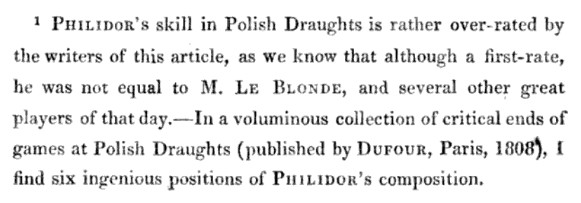
The distinction is important. Walker does not claim that Philidor was merely an average player: he only challenges the image of him as the undisputed champion of draughts that the Encyclopédie had helped to create. Other witnesses, by contrast, remained highly complimentary. Allen notably quotes Saint-Amant, who wrote in Le Palamède that Philidor was “of altogether superior strength” at draughts, while adding that he took less personal pride in the game than he did in chess.
Six Positions Attributed to Philidor
Fortunately, we are not limited to written accounts. In 1807–1808, M. Dufour’s Recueil de coups de Dames et de fins de parties difficiles (Google Books) was published in Paris by Everat. Its table explicitly attributes six positions to Philidor: nos. 3, 43, 86, 229, 274 and 322.
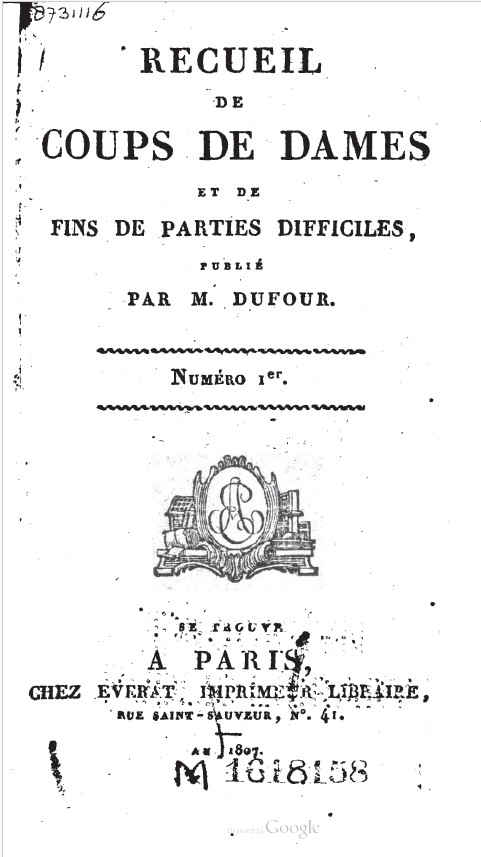
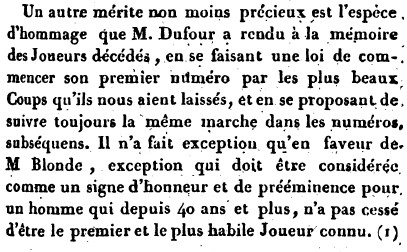
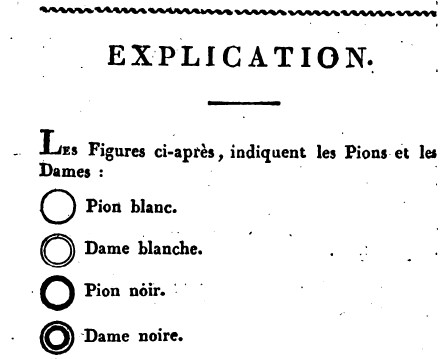
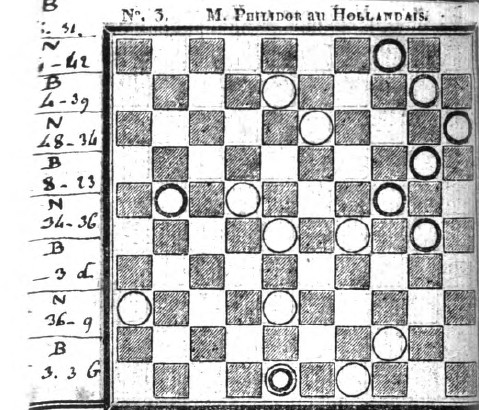
Some of the captions are particularly interesting:
No. 3: “M. Philidor against the Dutchman”;
No. 86: “M. Philidor against M. Léger”;
No. 229: “M. Philidor against M. C***”.
The name Léger is obviously intriguing, since a player of that name also frequented Parisian chess circles and is traditionally associated with the Traité des Amateurs. It could be the same man, although this cannot yet be stated with certainty.
I reconstructed all six positions in a study on the Lidraughts (lidraughts.org ) website in order to check the solutions given by Dufour. All six appear to be correct, although I am certainly not strong enough at draughts to assess them properly. You may need to create a Lidraughts account to replay them on the board.
These positions therefore constitute some of the very few technical traces available to us today with which to assess Philidor directly as a draughts player.
A Treatise on Draughts “by Sieur Philidor”
His reputation in this field was, in any case, sufficiently great to be commercially exploited. In 1785, a work was published in Amsterdam by Gaspard Heintzen under the title Traité du jeu de dames à la polonoise, par le Sr. Philidor, de l’Académie de Paris (https://resolver.kb.nl/resolve?urn=dpo%3A6187%3Ampeg21%3Apdf ) -> Treatise on the Game of Polish Draughts, by Sieur Philidor, of the Paris Academy.
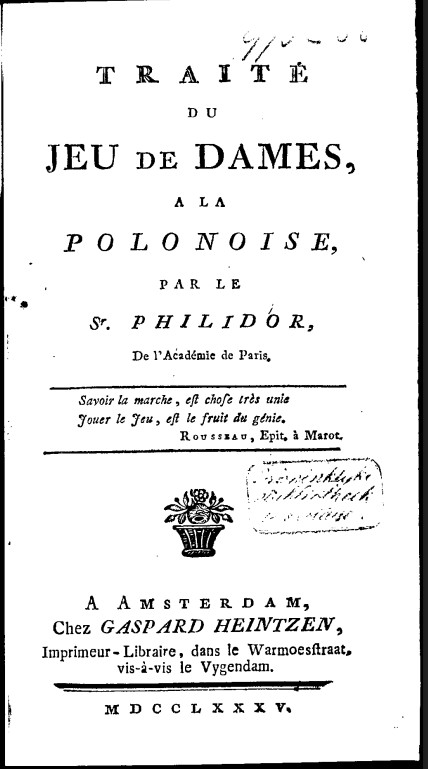
The title page leaves no room for doubt: the book is presented as a work by Philidor. Yet comparison with the volume published fifteen years earlier by Manoury is devastating. The genuine 1770 edition bears the title Essai sur le jeu de dames à la polonoise, “by Sieur Manoury, Marchand Limonadier, at the corner of the Quai de l’École”, published in Paris by Knapen and Delaguette. The 1785 text, however, is essentially Manoury’s book, with only a few adaptations.
Philidor Speaks in Manoury’s Words
The “Author’s Preface” provides an almost comical demonstration. In 1770, Manoury explains that he had come across a work entitled L’Égide de Pallas and decided to borrow from it whatever could be applied to the new game of Polish draughts. He writes in particular:
“I have appropriated everything I found in the Égide de Pallas…”
He then describes the rules, positions and combinations he assembled in his book. Fifteen years later, the supposed Philidor makes exactly the same claim in the first person: he too is said to have appropriated material from L’Égide de Pallas, gathered the combinations himself, and composed the work. Philidor is therefore quite literally made to speak in Manoury’s own words.
A Copy, but a Slightly Updated One
The Amsterdam edition is not, however, a simple mechanical reproduction. Someone revised and altered the text. Manoury wrote in 1770:
“In 1767, published by the widow Duchesne, an Almanach de perte & de gain appeared, …”
In 1785, the sentence becomes:
“In 1782, an Almanach de perte & de gain appeared…”
The editor therefore made an effort to bring the text up to date. More significantly, the work was adapted to Dutch customs. Manoury writes that “in Germany” the pieces are placed on the dark squares, contrary to French practice. The 1785 edition adds:
“in Holland & Germany.”
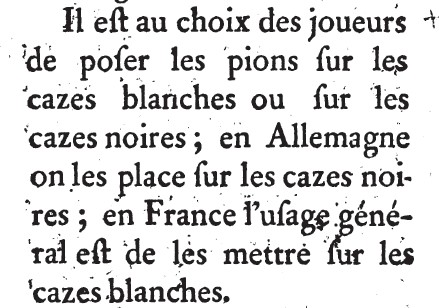
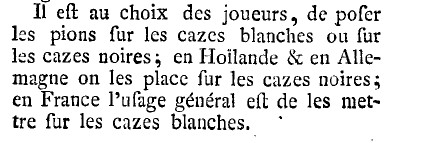
Manoury had the pieces move “from white to white”; in the Dutch version, they now move “from black to black”. We are therefore dealing with a genuine new edition adapted for a Dutch readership, but with Philidor substituted as the author.
An Oversight That Gives the Game Away
The transformation, however, was not perfect. Manoury’s book was entitled Essai sur le jeu de dames. The 1785 edition became a Traité. The editor remembered to alter some passages. Thus, the letter placed at the end of the book, which in 1770 was addressed to a lady “on sending her the Essay”, becomes in 1785 a letter “on sending her the Treatise on the Game of Polish Draughts”.
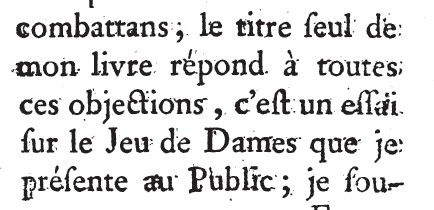
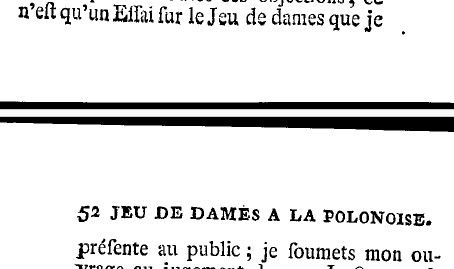
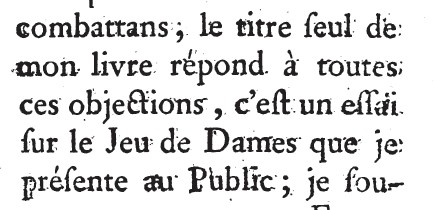
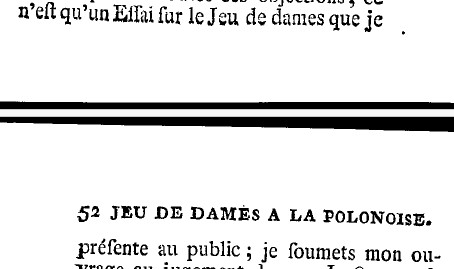
But one occurrence was overlooked. Just before the letter, in the conclusion of Philidor’s supposed treatise, we still read:
“it is only an Essay on the Game of Draughts that I present to the public.”
It would be hard to find a more revealing slip.
-
In Manoury’s book -
In the book fraudulently attributed to Philidor
And Manoury’s Privilege Naturally Disappears
The original 1770 edition also includes the official approval and royal privilege. This explicitly states that “Sieur Manoury, Marchand Limonadier in Paris” wished to have printed “a work of his own composition entitled: Essay on the Game of Polish Draughts.” In the Amsterdam edition, these pages have of course disappeared.
The reason is obvious: retaining the privilege would have rather undermined the attribution to Philidor. The 1770 privilege had, in any case, been granted for six years and had therefore long since expired by 1785. It is consequently more accurate here to speak of a plagiarized reissue or a false attribution than of piracy in the strict legal sense.
Why Use Philidor’s Name?
This is perhaps the most interesting question. Why would an Amsterdam bookseller have replaced the relatively obscure name of Manoury with that of Philidor? The answer seems fairly obvious: Philidor’s name sold books. By 1785, he had for decades been the most famous chess player in Europe. More importantly, the Encyclopédie and the Correspondance littéraire had also helped spread the image of Philidor as an extraordinary draughts player.
Attributing a treatise on draughts to Philidor would therefore have seemed entirely credible to a contemporary buyer. Paradoxically, this false attribution thus provides further evidence of his reputation as a draughts player.
So How Strong Was Philidor Really?
It would be unwise to accept without qualification the Encyclopédie’s claim that Philidor was the greatest draughts player who had ever lived. George Walker, who knew both games well, certainly regarded him as a first-rate player, but placed him below some of the leading specialists, such as Le Blonde.
On the other hand, the contemporary accounts of 1755 and 1770, his activity in Holland, the recollections recorded by Le Palamède, and above all the six positions preserved by Dufour show that he was certainly no mere amateur.
The most reasonable conclusion is probably this: Philidor was a very strong draughts player, recognised as such by his contemporaries, but his fame probably magnified his actual strength to the point that he was sometimes portrayed as being to draughts what he unquestionably was to chess.
And the little Amsterdam book of 1785 ultimately provides an unexpected piece of evidence: fifteen years after Manoury, all that was needed was to erase his name and put “Philidor” on the cover to make a treatise on draughts considerably more prestigious!