

Serendipity strikes again ...
Just in time for my friend Bob van de Velde's 89th birthday (March 26th) and the 25th anniversary of the Emanuel Lasker Society, "guided coincidence" bestowed upon me a wonderful birthday present. It all started with this email from Anthony Saidy (also born in 1937), a longtime Lasker enthusiast and member of the CH&LS. Highest Level with Modest Participation
Tony wrote on February 10, 2026, in his usual style:
Reminds of an exchange I had in 1978 with a Soviet colleague.
"I saw where a bridge club in L'Grad was shut down by the police. Why?"
"We are not to do such things without authorization."
In the mid-1930s the great German-Jewish world champion (holding the crown for 27 years until 1921) also a mathematician & philosopher, made a move eastward w. his wife. Incredibly, at age 66 he sailed through the Moscow 1935 intl. tournament w/o a single loss, just a half-point behind the winners.
But Lasker did not like USSR at the height of the purges (all foreigners being under suspicion) and skirted to the scene of his overwhelming 1924 tnt. victory well ahead of the man who had dethroned him, NY.
There he found living under FDR more copacetic than either Hitler or Stalin. After all, it was his friend Einstein's adopted country. He died there in 1941 at 72 - and my oblivious(to chess) parents had not taken me at 4 to meet him. (Yes, I also walked on earth with Capablanca and Alekhine.)
He was adept at more than one game and even created his own, "Laska." It didn't catch on anywhere more than the chicken farm that the chess colossus once tried to run near Berlin.
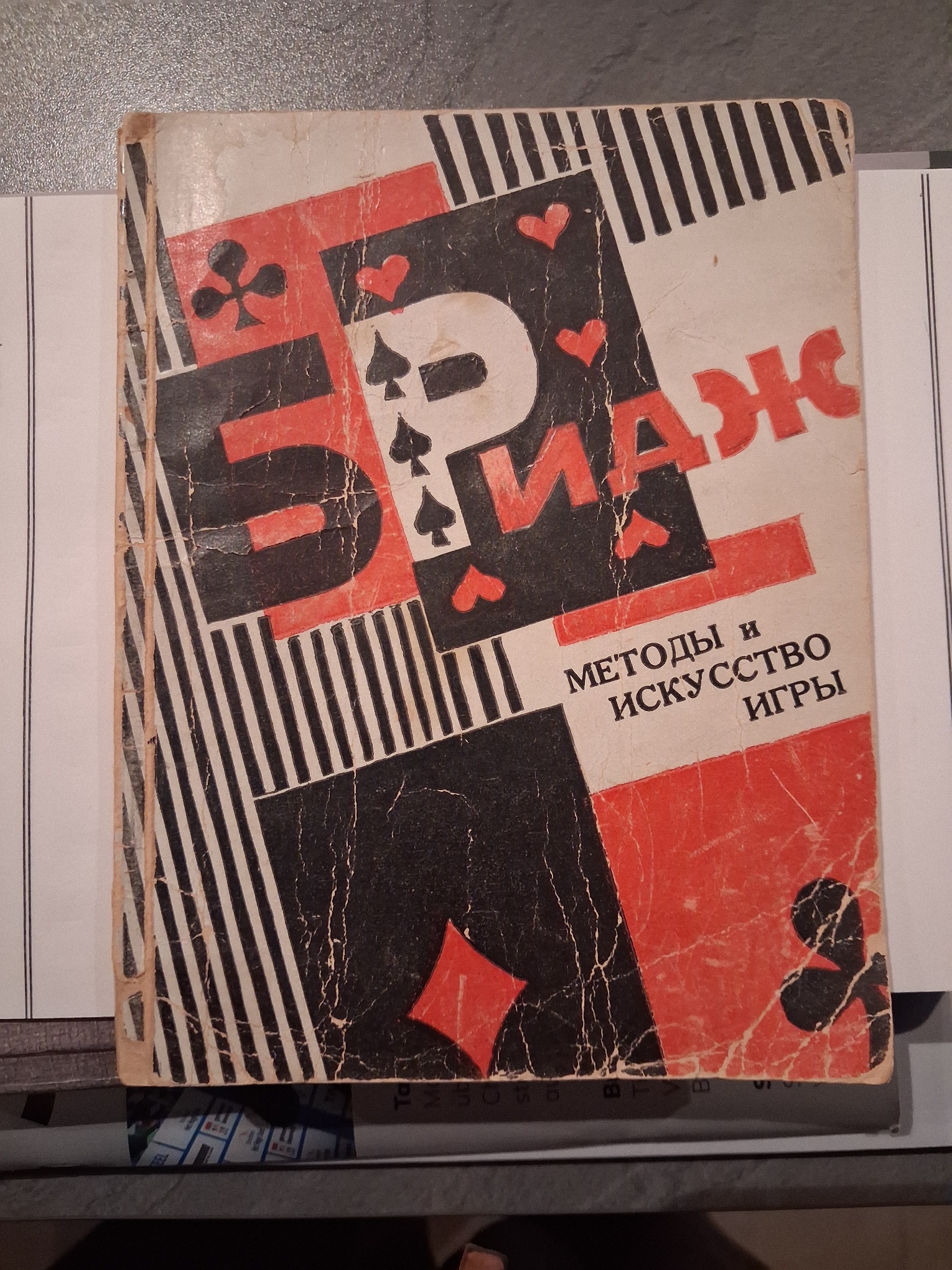
Lasker Bridge Methods and Art of Playing. Riga 1930s. Russian avant-garde book bridge
Pre-owned $99.99 + $10.00 delivery, located in Latvia
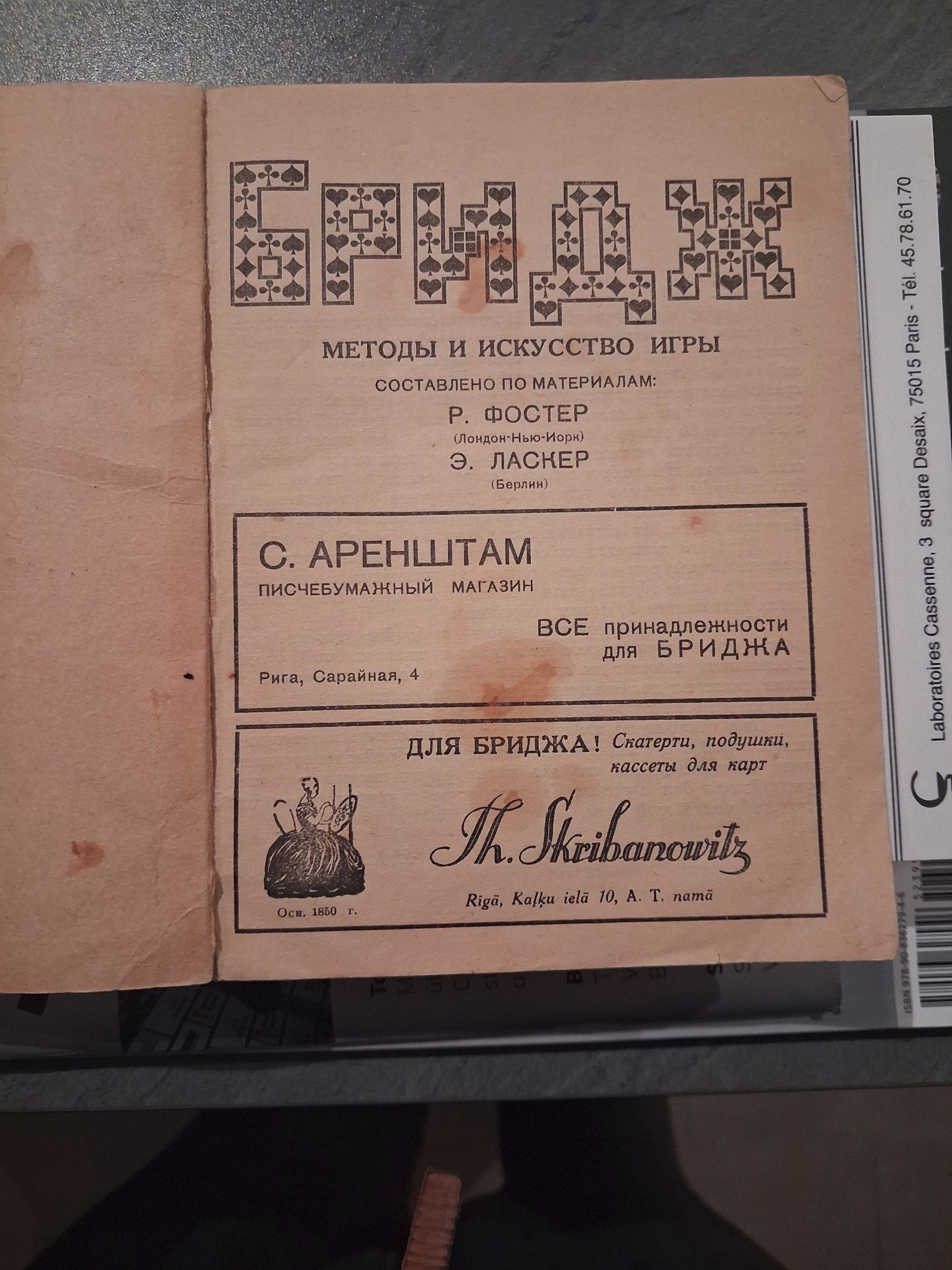
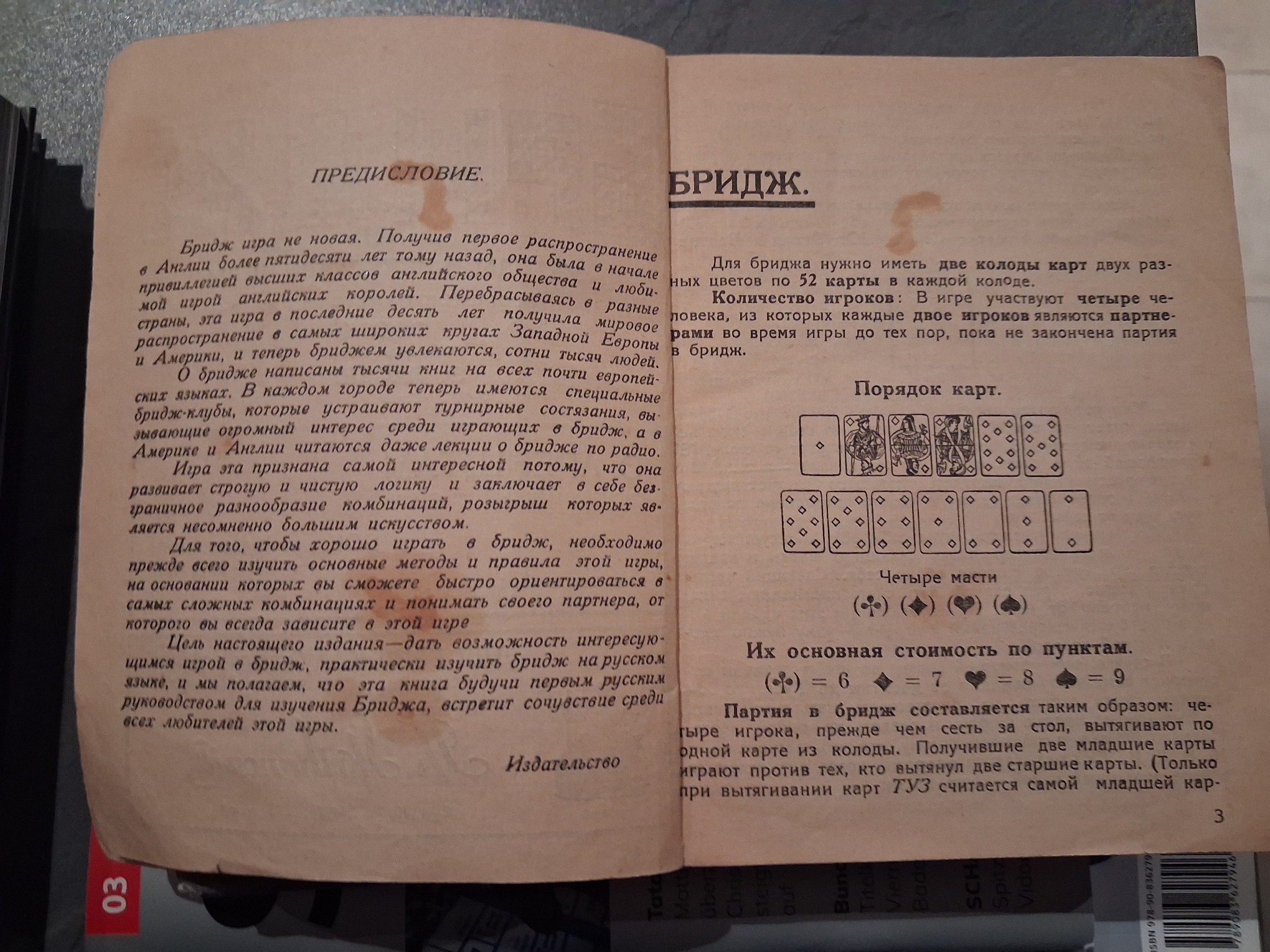
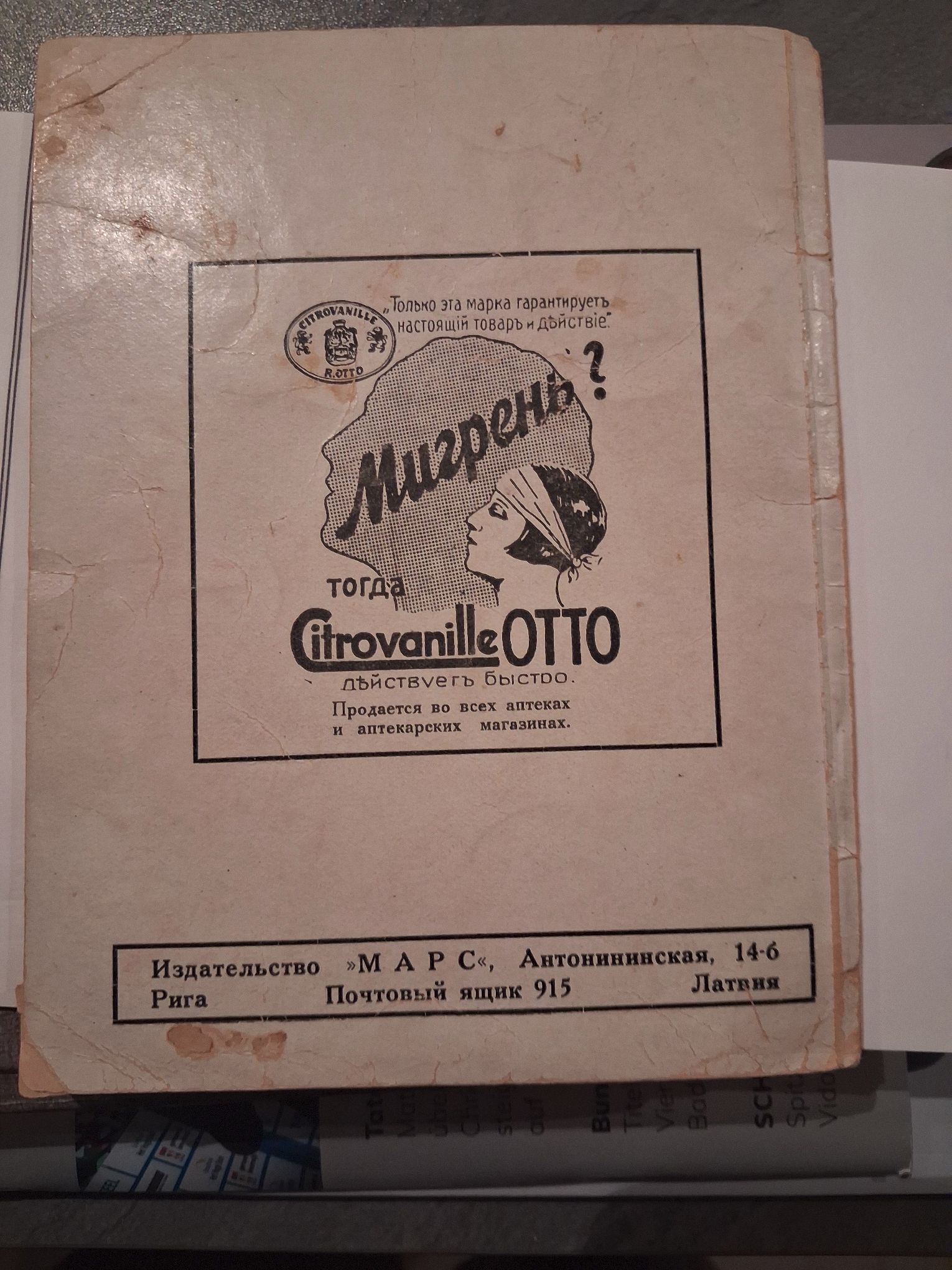
Naturally, I was "electrified" and, since Tony declined, was able to acquire the book at the "cost price." And contrary to the eBay listing, it was complete—a fantastic find!
Although Emanuel Lasker is primarily known as a world chess champion, he was also a first-rate bridge player. He developed his own theories and published Das verständige Kartenspiel (The Intelligent Card Game - published as Encyclopedia of games Volume I Card Strategy, Dutton 1929) with Scherl, Berlin, in 1929, which included a detailed chapter on various bridge variants. Robert Frederick Foster (1853–1945), also listed as an author, was one of the world's leading experts on whist and bridge and invented the so-called "Foster Echo" rules. (https://en.wikipedia.org/wiki/Robert_Frederick_Foster)
Bob van de Velde presents Lasker's contributions to this strategic card game in detail in the 2009 Lasker monograph Not Only Chess, but especially in Emanuel Lasker Volume II (2020), Lasker as a Bridge Expert. Lasker certainly engaged intensively with the then-prevalent theories of experts like Foster to refine his own understanding of the game. However, a relationship between R.F. Foster and Emanuel Lasker was not discussed.
This Russian-language booklet about bridge by R. Foster and Em. Lasker, published at the end of 1932 by the MARS publishing house in Riga, seems to be a rare collector's item.
- Title: Бридж Методы и искусство игры (Bridge Methods and Art of Play)
- Authors: “Составлено по материалам” (Compiled from materials by): Р. Фостер и Эм. Lasker (R. Foster and Em. Lasker)
- Publisher: MARS, Riga (December 1932)
- Extent: 54 pages
It was published in Russian, as Riga was an important center for Russian-language publications in the Baltic region before World War II. The preface states, among other things: "...that this book, being the first Russian guide to the study of bridge, will find favor with all enthusiasts of the game." This is confirmed by a bibliography of Russian-language bridge literature. (Can be directly translated into English.) (https://ftp.bridgescanner.com/Pages/BSSB/Old_site/Misc/LiteratureRus.html)
In November and December 1932, Riga's leading Russian-language daily newspaper, Segodnya (Today), advertisements from the MARS publishing house appeared (coinciding with Lasker's visit). The pamphlet was listed among "New Releases" or "Practical Guides." The announcement simply read "Bridge, Foster and Lasker." It was sold at the time for about 1 to 1.5 lats — a typical price for popular pamphlets of the 1930s.
This booklet summarizes the rules and strategies of bridge, drawing on the then world-renowned authorities: Robert Frederick Foster provided the technical basis and the interpretations of the rules (often based on his Foster’s Bridge Manual). The scoring system explained in the booklet corresponds to so-called Auction Bridge (or an early form of Contract Bridge), as presented by Foster in his manuals in the late 1920s. Emanuel Lasker contributed the game-theoretical and mathematical considerations he had developed in his own bridge studies. E.g. Page 35 explains the "game system" and the "distribution of forces." Interestingly, mathematical probability is emphasized here — a topic that clearly bears the hallmarks of Emanuel Lasker. Lasker was known for viewing card games not merely as games of chance, but as stochastic problems. It explains how to assess the strength of a hand in order to make the correct announcement.
This is likely based on the corresponding chapter in Das verständige Kartenspiel, a Latvian edition of which (*Prātīga kāršu spēle*) was published in 1931 by Burtnieks in Riga. Ultimately, Lasker's name was certainly the "figurehead." This "joint" publication is a so-called edited volume, containing texts by both authors to unite the different schools of bridge (Foster's technical approach and Lasker's logical approach). There was certainly no active collaboration between the two on a single manuscript.
Emanuel Lasker was a guest at the Riga Chess Club on December 20, 1932, for a simultaneous exhibition (he won 21 games, lost 2, and drew 5). Such visits were celebrated like state visits at the time. For a publisher like MARS, Lasker's physical presence in the city was the perfect opportunity. It is very likely that the booklet was published to coincide with this visit and was thus heavily promoted. In the Latvian press (e.g., the Russian-language newspaper Segodnya), Lasker was announced not only as a chess genius but also explicitly as a bridge authority.
The booklet is missing from the Meissenburg bibliography on Emanuel Lasker:
Egbert Meissenburg (1937-2023) Bibliography of Lasker's Writings, edited by Richard Forster (as of 2020), in Emanuel Lasker Volume III (Exzelsior Berlin 2022), essentially the gold standard of Lasker scholarship.
Thus, a wonderful birthday find for Bob van de Velde and the Emanuel Lasker Society. My special thanks go to Tony Saidy, who will celebrate - hopefully in best shape - his birthday on May 16th.
Michael Negele