

On firzán, alferza, reyna and dama
Here is a new text by José A. Garzón, whom I would like to thank. He told us about in Valencia last September.
You can find a summary in English and download the full text in Spanish in PDF format.
It was published in the book Pasiones Bibliográficas 8, which has just been released, edited by the Societat Bibliogràfica Valenciana Jerònima Galés.
Summary in English
The article examines the origin, naming, and nature of the queen in chess, arguing that the late 15th-century reform of the game was not the result of a gradual feminization of an existing piece, but rather the creation of a completely new piece, endowed with a new name, a new movement, and a new strategic role.
In ancient and medieval chess (shatranj), the piece next to the king was called ferz (or firzán, alferza) and had a very limited range of movement. In medieval Europe, under the strong influence of Jacobus de Cessolis’ moral treatise, the piece was often referred to as regina or domina in Latin, and reina in Romance languages. However, these feminine names did not bring about any change in the rules.
The core argument of the article is that the term dama does not represent a simple linguistic shift, but appears exclusively with the birth of modern chess, first attested in the poem Scachs d’amor (Valencia, c. 1475), the foundational text of the reform. The authors of the poem did not merely rename a piece: they deliberately created a new chess piece, initially conceived as a "total piece" combining the movements of all others, except the knight, whose inclusion was eventually rejected as impractical.
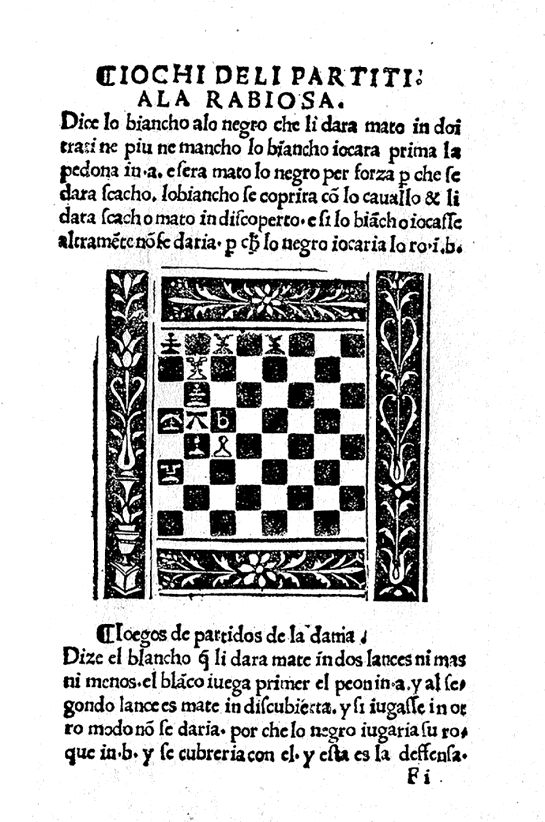
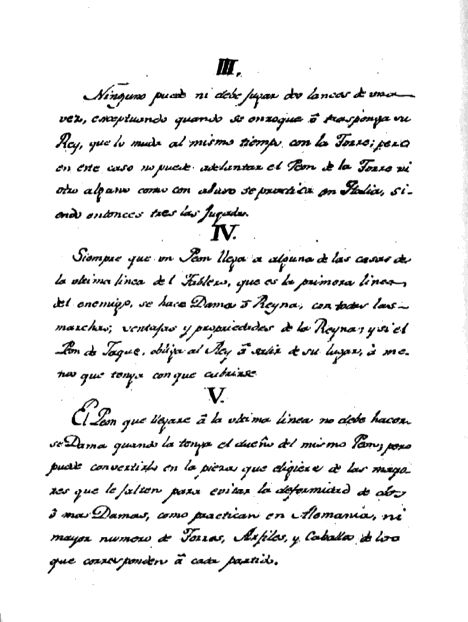
A systematic analysis of early sources shows that in all technical Spanish chess treatises of the first century of modern chess, the piece is consistently called dama. Medieval terms such as reina, regina, or alferza survive only in moral, allegorical, or transitional contexts. The shift from reina to dama therefore marks a conceptual break, not a linguistic continuity.
The article also critically examines attempts to link the powerful queen to a real historical woman (such as Isabella the Catholic). These interpretations are considered secondary and largely symbolic: the reform is fundamentally technical and internal to the game. Political references in Scachs d’amor do exist, but they are allegorical and sometimes even critical rather than celebratory.
Finally, the introduction of the queen, together with the modern bishop, radically transformed chess. Jumping pieces (except the knight) were abandoned, long-range movement became dominant, and the game shifted toward strategy, tactics, and opening theory. This was not a slow evolution, but the creation of a new game, explicitly identified by contemporaries as the chess of the queen (axedres de la dama).