

How a Belgian researcher reconstructed a nearly 1.800-year-old Roman board game with the help of AI
[Note by Henri Serruys: This article was published on 10 February 2026 in Dutch on the website of the Flemish Radio and Television Company (VRT).]
Author: Kasper Nollet (VRT NWS)
A mysterious stone that has been gathering dust for years in a Dutch museum may in fact be an ancient Roman board game. This emerges from a Belgian study reported by RTBF. Using a specialised AI model and an extensive database of historical board games, the researchers even managed to unravel how the nearly 1,800-year-old game was once played.
Summary:
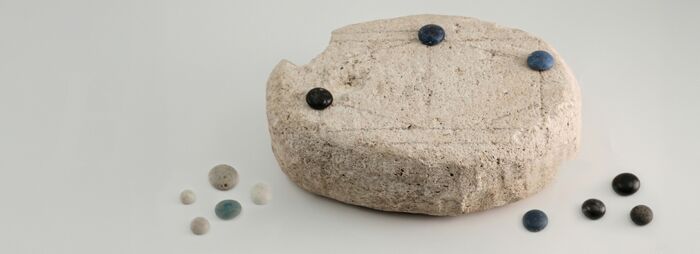
• An international research group led by AI scientist Eric Piette (UCLouvain) has determined that a mysterious stone in the Roman Museum in Heerlen is an ancient Roman board game, dating from approximately AD 200 to 400.
• With the help of a specialised AI database and simulations, the researchers discovered that it is a blocking game.
• “The patterns and possible rules correspond strikingly well with games from the eighteenth and nineteenth centuries in Scandinavia,” says Eric Piette (UCLouvain), “which points to early cultural influence between the two regions.”
For decades, the Roman Museum in Heerlen has kept a remarkable object in its collection: an old stone discovered near the nearby Villa Coriovallum. Because of the conspicuous lines on the stone, the museum had long suspected that it might be an ancient game board, but conclusive proof was lacking.
Eric Piette (UCLouvain) and his research team have now changed that. Piette is an AI scientist with a particular specialisation: deciphering historical board games with the help of artificial intelligence. “I worked for several years at Maastricht University, and during that period colleagues and I came across the stone in the Roman Museum,” he told VRT NWS.
Together with his team, Piette decided to re-examine the stone using modern AI technology. “In an initial analysis of the surface we observed traces of use indicating that repeated movements had taken place across the stone,” he explains. “That suggested it might indeed be a game board.”
To confirm this suspicion, the researchers used specialised AI software. It was able to compare the wear patterns on the stone with thousands of games in an extensive historical database. The result was decisive: after countless analyses and simulations, Piette and his team now believe they know what kind of game it was. The investigation was far from simple.
Blocking game
During his time in Maastricht, Piette had already begun working with several colleagues on the so-called Ludii project. This project aims to map all board and card games from the past to the present and to train a large AI model on them.
“The real strength of this research lies in that enormous games database,” says Piette. “We can include both modern and ancient board games, from Egypt to America, and representing very diverse styles of play.” On the Ludii website all the games are displayed on a world map.
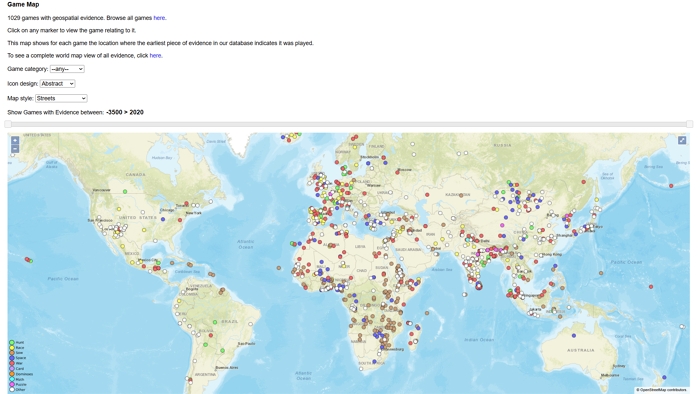
Ludii not only records these games but also contains software that allows them to be played. This proved useful in the search for the Roman game from Heerlen. The initial analysis of the wear patterns had revealed six possible arrangements of pieces, but the team still had to determine how the game was actually played.
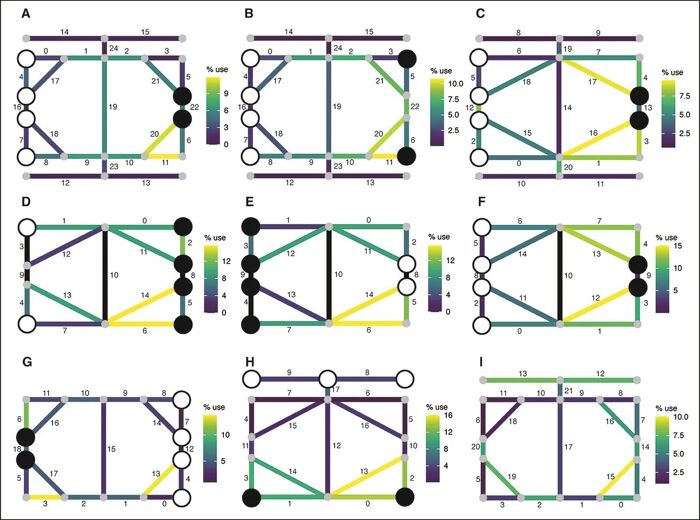
“We therefore deployed various AI-driven players to test thousands of game variations on the Dutch stone.” A problem soon emerged. “The game seemed intended for two players, but one AI player kept winning repeatedly, while the other allowed itself to be defeated,” Piette explains.
“In the end it became clear that it could only be one fairly simple type of game: a blocking game. In such a game, both players have a different objective, and one player’s main aim is to block the other from achieving that objective.”
Given the findspot of the stone near the Villa Coriovallum, the researchers named the game ludus coriovalli (“game from Coriovallum”).
Link with Scandinavia
According to Piette, the discovery is historically very interesting. He attempted to date the stone and arrived at a period between roughly AD 200 and 400, around the end of the (Western) Roman Empire.
“What is remarkable is that the patterns and possible rules correspond strikingly well with games whose rules were only recorded much later, in the eighteenth and nineteenth centuries in Scandinavia,” he says.
This suggests that cultural influence between the two regions may have begun much earlier. Certain gaming traditions or ideas may have spread over great distances and survived for centuries. “This also fits the broader picture of the Roman Empire in its final phase: an empire increasingly characterised by hybridisation through contacts with other peoples and cultures.”
Next target lies in Brussels
Piette and his Ludii team hope to carry out similar research more frequently in the future. “The database is the result of more than five years of work in Maastricht, but the project is far from finished. That is why we now collaborate internationally,” he explains.
He already has a new target in mind, this time closer to home, in Brussels. “At the Royal Museums of Art and History there is a striking game table made of clay from ancient Egypt,” he says.
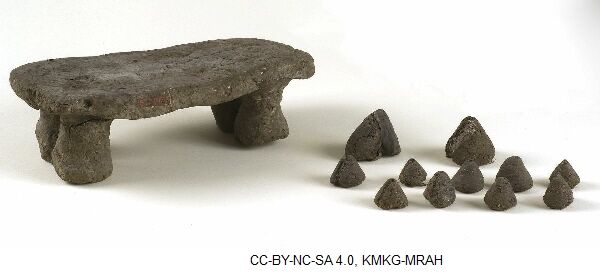
“At present this may be the oldest game table known in the world. We would very much like to investigate it, for example by reconstructing through 3D simulations how it was originally intended to be used.”
You can play the game Ludus Coriovalli on the Ludii website.